Slice Business Current Account Review 2026: Zero Balance, Fast Setup, and One Thing Nobody Mentions
Opened a Slice current account for my firm in 2026. Zero balance, 10-minute VKYC, no branch visit. But there is a name mismatch issue most users only discover after opening. Here is the honest take.

I opened a Slice business current account on my firm name about two weeks ago. The whole process took around 10 minutes, the account was live within minutes of finishing, and I never had to step into a branch or send a single physical document.
For a business current account in India, that kind of experience is still unusual.
That said, after using it for a bit, I noticed something that Slice does not clearly mention anywhere on their app or website. It matters depending on why you are opening the account. So before anything else, let me cover the full picture.
What Is Slice Business Current Account
Slice started out as a fintech credit card company and merged with North East Small Finance Bank in 2024, which gave it a full banking licence. The business current account came as part of their push into small business banking.
The basic pitch: zero minimum balance, fully digital account opening, free UPI QR code for receiving payments, and no paperwork or branch visits. Aimed at freelancers, small shop owners, online sellers, and solo service providers who want a clean business account without the traditional bank hassle.
Documents You Need
The document requirement depends on whose name the account should open under.
To open on your firm or business name, you need both an Udyam registration certificate and a GST certificate. These two documents are how Slice verifies the business and links the account to your firm name.
If you do not have Udyam registration yet, it is free and takes around 10 minutes at udyamregistration.gov.in. There is no fee and no waiting period for most businesses. Get this done first before you start the application.
To open on your personal name, GST is optional. Basic KYC documents work.
The choice between these two paths matters more than it seems, and the next few sections explain why.
How the Account Opening Works
The process was genuinely smooth. Faster than anything I have done with a traditional bank.
You open the Slice Business app, fill in your basic details, and verify your number with an OTP. Then comes the VKYC, which is a short live video session where you hold up your PAN card to the camera and take a selfie. The whole session is three to four minutes.
From starting the app to completing VKYC, it was about seven to eight minutes. My account was active a few minutes after that.
Compare this to opening a current account at a scheduled commercial bank. Most of them need a branch visit, physical copies of documents, sometimes a reference from an existing account holder, and a waiting period of several days for business verification. Some branches also require a personal meeting with a relationship manager.
Slice skips all of that. If you have your Udyam certificate and GST number ready, you can have an active current account before lunch.
Looking at all zero balance current account options for small businesses? Here is a full comparison across 12 banks in India
Zero Balance, No Monthly Charges
There is no minimum average balance requirement on the Slice business current account as of now. No MAB means no penalty charges if your account sits low on a particular month.
There are also no monthly maintenance fees currently. NEFT, RTGS, and IMPS are free up to a reasonable limit per month. First cheque book is free.
For a business that is just getting started and does not want to lock up capital in a minimum balance, this removes one of the bigger friction points of having a separate business account.
Worth noting: "no charges currently" means Slice can introduce fees later as the product matures. Check their current Schedule of Charges before opening if you are reading this long after May 2026.
The Name Mismatch Issue Nobody Talks About
This is the part I want to be upfront about, because it surprised me and I think it will surprise others too.
After my account activated, I opened Google Pay and PhonePe to verify my account details. When I entered my account number and IFSC as you would for a regular bank transfer, both apps showed my personal name, not my firm name. Not the business, not the trade name on my Udyam certificate. Just my individual name.
I then checked the UPI ID and QR code that Slice provides separately. Those did show my business name correctly. So within UPI payments, the business name comes through fine when someone scans the QR or pays via UPI ID.
But the moment anyone does a standard bank transfer lookup using the account number, what shows up is the individual's name.
I downloaded my bank statement to confirm. The statement header shows my personal name at the top, not the firm name.
What this means in practice: the account is technically an individual account with a merchant UPI layer on top. Slice registers the UPI handle under your business name, which is why QR payments show the business name. The underlying bank account itself is in your personal name.
I am not the only person who found this. After noticing it myself, I came across this review on the Google Play Store for Slice Business from May 2026:
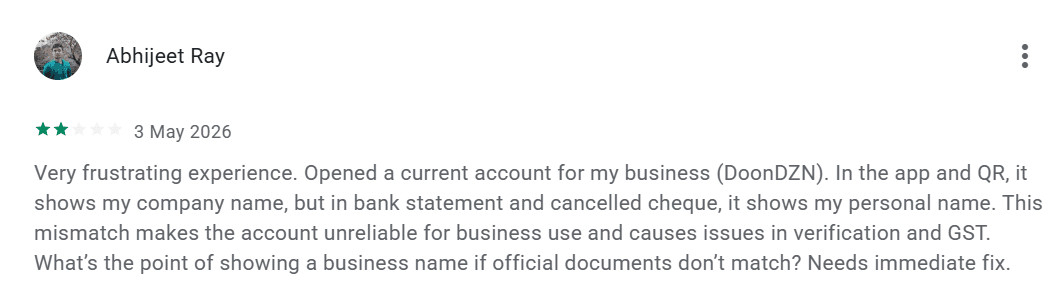 Abhijeet Ray's Google Play review highlighting the business name mismatch issue on Slice current account — bank statement and cancelled cheque show personal name instead of firm name
Abhijeet Ray's review captures the same problem precisely. The business name shows up in the app and on QR payments, but the bank statement and cancelled cheque both show the personal name. That mismatch creates problems when the account is needed for official business verification, GST portal use, or any process that checks the legal account holder name.
For most small businesses collecting daily payments via UPI, this does not create a practical problem. But if you need the account to formally represent your business entity for verification purposes, it will not work the way you expect.
Slice is a young product and may address this over time. For now, go in knowing this upfront.
Features Worth Knowing
Free QR standee: Slice sends you a physical QR standee that you can place at your shop, counter, or desk. Customers scan it to pay via UPI. No charge for this.
UPI Sound Box: A monthly paid QR sound box is available if you want audio payment confirmations, useful for busy setups where watching your phone is not practical. Monthly charge applies.
UPI payments work cleanly: The QR code shows your business name and payments settle fast. This is the strongest part of the product for day-to-day use.
No physical branch network: Slice is digital-only. There are no branches for cash deposits. If any part of your revenue comes in as cash, this account will not work for you.
Debit card: A virtual card is available immediately. Physical debit card issuance is also available with no annual maintenance fee currently.
Who Should Open This
The Slice current account works well if you are:
A freelancer or independent consultant who bills clients via bank transfer or UPI. You want a clean business account for income, and you want it set up quickly without a branch visit.
A small online seller receiving payments through UPI QR codes, payment links, or gateway settlements. Zero balance means no idle capital cost and the setup is minimal.
An early-stage business owner who wants to keep business and personal transactions separate from day one, even if formal legal account-level registration is not yet a priority.
A small shop or service provider whose customers mostly pay via UPI. The free QR standee and instant UPI settlement are genuinely useful here.
Who Should Look Elsewhere
If your business handles regular cash, this does not work. No branches means no cash deposits.
If you need the account for formal business verification, including GST portal registration in the firm name, vendor onboarding processes that check legal entity name on the account, or government portal submissions, the name mismatch on bank transfers and statements will cause issues. For that purpose, a traditional scheduled commercial bank current account opened properly on your business registration is the right choice.
If you are a registered company, LLP, or partnership firm that needs the account to legally reflect the business entity as the account holder, this account does not meet that requirement currently.
Once your business banking is sorted, here is how to start investing business profits systematically with even small amounts
Final Take
The Slice business current account is one of the fastest and most painless ways to get a zero balance account running for a small business in India. The onboarding beats anything a traditional bank offers. The UPI experience is smooth and the free QR standee is a practical touch.
The name mismatch at the bank account level is a real limitation and worth knowing before you apply. For collecting UPI payments and managing day-to-day business income, it does not matter. For anything that requires the account to formally represent your business entity, it does.
It is a fintech product still finding its footing. Some of these gaps will likely close as Slice matures. For now, pick this if you want speed, zero balance, and easy UPI collection. Pick something else if legal account ownership is part of why you need the account.
For a business just starting out that wants something free, fast, and genuinely simple to open, it is still one of the better options available right now in India.
Account details and charges are accurate as of May 2026. Slice may update pricing, features, or terms. Always check the current Schedule of Charges before opening any account.
Frequently Asked Questions
Is the Slice current account truly zero balance?
What documents does Slice need to open a business current account?
Does the Slice business current account show your business name in bank transfers?
Can I open a Slice current account online without visiting a branch?
Does Slice have physical branches for cash deposits?
Is the Slice business current account good for freelancers and small businesses?

Ranjit Parmar
ranjitparmar.in ↗Writing about personal finance the way a smart friend would explain it — no jargon, no filler. I started KnowMoney because most finance advice in India is either written for MBAs or it's a sales pitch.